Most people wait for headlines. By then, it's too late. Before a ticker heats up, there's a brief signal phase — a quiet shift that appears before the noise. No alerts. No buzz. Just an early tell for those who know where to look.
The FREE Market Signal Brief from the Daily Edge Report breaks down exactly how to spot these setups before they explode into the news cycle. Once the story hits — the early edge is already gone. Don't wait.
Download Your Free Signal Brief NowWe encourage readers to perform their own research and due diligence on any information we provide. By clicking the link above you will automatically be subscribed to the Daily Edge Report Newsletter. To view our privacy policy, visit lifewatermedia.com/privacy-policy.

Tonight we're celebrating the things that brought us joy — from the arcade on Main Street to the classics that ruled the road

Image via Atlas Obscura
A Museum That Remembers When Games Meant Gathering Together
All the way in West Perth, Australia, there's a place called the Nostalgia Box that's doing something wonderful — preserving the history of video games from the 1970s right through the early 2000s. Over 100 consoles are on display, each one a little time capsule of an era when entertainment was changing faster than any of us could have imagined.
I still remember the first time I saw Pong at a diner in 1975. Two white lines, a bouncing dot, and somehow it felt like magic. The kids crowded around that machine like it was something from outer space. Within a few years, every pizza parlor and bowling alley had a corner filled with the glow of Pac-Man and Donkey Kong, the sound of quarters dropping and kids cheering each other on. Those games brought us together in a way that's hard to explain to someone who grew up with a screen in their pocket.
What strikes me about a museum like this is that it's preserving more than just old electronics. It's preserving a time when new technology still felt communal, when you had to go somewhere to play, when high scores were written on paper taped to the machine. From the Atari 2600 that made Christmas morning unforgettable in 1980, to the Nintendo that kept grandkids entertained on rainy afternoons, these weren't just toys — they were the backdrop to millions of family memories.
📺 Jack's Thoughts: There's something both sweet and a little sad about needing a museum to remember when entertainment brought people into the same room instead of isolating them in separate ones. But I'm grateful someone's doing it. The kids who visit will see that fun didn't always require an internet connection.

Image via Country Living
Country Star Gives Fans the Kind of Surprise TV Used to Deliver Every Week
Riley Green, the country singer who's been climbing the charts with his straight-ahead, no-nonsense country sound, recently gave his fans something they'd been hoping for — a reunion with Ash Santos, his co-star from the TV series Marshals. Green brought Santos on stage during one of his concerts, and from the photos, you can see the pure delight on fans' faces.
For those who didn't catch it, Marshals was the kind of show that reminded folks of the Westerns and cop dramas we grew up with — good guys, bad guys, and a clear line between them. Green played a U.S. Marshal trying to keep order, the kind of role that would've been right at home on Thursday nights back when families actually gathered around one television set. When a show connects with people that way, they don't forget it. They want to see those characters again, want to believe that world still exists somewhere.
What Green did was simple — he listened to his fans and gave them a moment of joy. No algorithm suggested it, no focus group tested it. Just a performer who understood that people get attached to stories and the folks who tell them. That's the kind of thing that happened all the time when Ed Sullivan or Johnny Carson were running the show, when entertainers saw themselves as having a relationship with their audience, not just a social media following.
📺 Jack's Thoughts: In an age when every reunion is calculated for maximum streaming revenue, there's something refreshing about a simple surprise that's just meant to make people smile. Riley Green seems to understand what a lot of modern entertainment has forgotten — fans aren't customers, they're people who invited you into their lives.
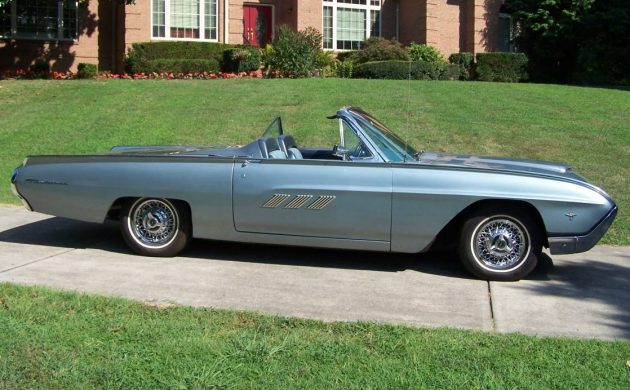
Image via Barn Finds
When Thunderbird Meant Something Special on Main Street
A rare 1963 Ford Thunderbird Sports Roadster has surfaced, one of just 455 ever made. The Sports Roadster was Ford's attempt to recapture some of the two-seat magic of the original 1955 Thunderbird after they'd added a back seat in 1958 and created an entirely new category — the personal luxury car. With its distinctive fiberglass tonneau cover and Kelsey-Hayes wire wheels, the Sports Roadster was Ford's way of saying you could have elegance and excitement in the same package.
I remember when Thunderbirds were the car every successful man in town seemed to drive. The doctor had one. The bank president had one. They weren't flashy like a Corvette, but they weren't stuffy like a Cadillac either. They were sophisticated, the kind of car that said you'd made it without needing to shout about it. When Ford added that back seat in '58, they sold over 37,000 of them in the first year alone — suddenly you could take the family out in style, not just your best girl.
The Sports Roadster was Ford's acknowledgment that maybe they'd lost something when they went practical. Only 455 people bought one in 1963, which tells you something about American priorities then — most folks wanted the back seat, wanted the practicality. But those 455 buyers wanted something more — they wanted a piece of automotive jewelry, something that would still turn heads at the country club thirty years later. And here we are, sixty-three years on, and it still does.
📺 Jack's Thoughts: Ford learned what a lot of companies seem to be relearning today — sometimes when you try to be everything to everyone, you lose the very thing that made you special in the first place. That Sports Roadster was Ford admitting they missed the plot, and there's something admirable about a company that can admit that, even if the market didn't reward them for it.
Tonight, whether it's an old game console, a surprise reunion, or a classic car, I'm reminded that the things we loved didn't just disappear — they're still out there, waiting to remind us of who we were and, maybe, who we still are. Sleep well, friends. Tomorrow's another day to appreciate what endures.
— Jack Reynolds