Today’s Sponsor
America's national debt has blown past $40 trillion — and we're adding another trillion every five months. Interest payments alone now top $1 trillion a year, meaning borrowed money is paying interest on borrowed money. Economists call this a debt death spiral, and your retirement savings could be caught in the middle.
A new free report reveals the three ways governments escape a debt spiral, how purchasing power quietly erodes, and exactly how to move a portion of your savings into a financial safe haven before it's too late. No cost. No obligation. Delivered to your inbox in minutes.
Get the Free Debt Death Spiral ReportThis is an advertisement from American Alternative Assets. If you no longer wish to receive these promotions, unsubscribe here. American Alternative Assets | 21700 W Oxnard St, Suite 850, Woodland Hills, CA 91367.

Monday night reflections on the things we built to last, the songs that told the truth, and the history we shouldn’t let disappear.
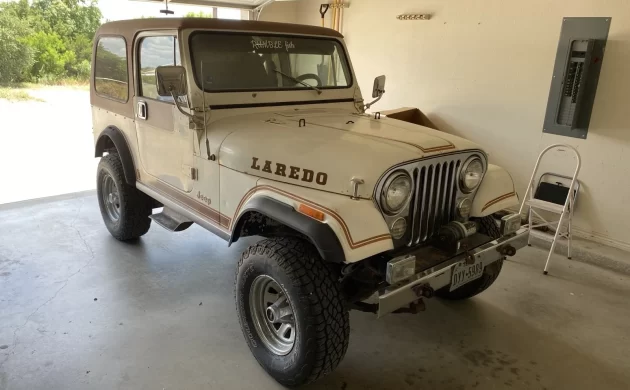
Image via Barn Finds
That Unrestored 1983 Jeep CJ7 Laredo and the Kind of Tough That Didn’t Need Explaining
There’s something steadying about seeing an unrestored 1983 Jeep CJ7 Laredo still wearing its years honestly. Back when AMC was building these, the shape was simple, upright, and purposeful, like it was drawn with a carpenter’s pencil instead of a committee meeting. You didn’t buy one to impress anybody at the mall; you bought it because you wanted to go where the pavement ended and come home again.
The Laredo package always felt like the right mix of rugged and respectable, a little extra comfort without losing the point of the vehicle. In the early ’80s, a Jeep like this meant fishing trips, hunting camps, Saturday hardware runs, and the kind of work boots life that didn’t need a slogan. It’s a reminder that “timeless” isn’t a marketing word when the design really earns it.
There’s a special value in an unrestored survivor, too. It hasn’t been scrubbed into a glossy version of history; it’s simply made it through, one season at a time, like a good tool passed down in the family.
📺 Jack's Thoughts: I’ll take honest wear over perfect paint any day, because it tells the truth about how Americans used to live: we bought things to use them, not curate them. Vehicles like this CJ7 remind me that freedom isn’t an abstract idea; sometimes it’s as plain as a sturdy set of keys and a road that turns to gravel. I hope the next caretaker keeps it simple and lets it stay what it is.

Image via Far Out Magazine
Bruce Springsteen’s 1982 Moment: When the Boss Got Quiet and Somehow Spoke Louder
In 1982, Bruce Springsteen put out an album that didn’t roar like an arena and didn’t shine like a radio single. It was lean, uncertain, and vulnerable, the kind of record you listen to late, when the house is quiet and the day’s worries finally sit down beside you. For a lot of us who grew up in the ’70s and ’80s, that honesty felt like a hand on the shoulder more than a performance.
The fascinating thing is how younger fans have kept circling back to it, asking him about that album more than the big, famous ones. Maybe it’s because confidence is easy to fake, but doubt is harder to manufacture. When Springsteen let the edges show, he gave people permission to admit their own fears and keep going anyway.
It’s a good reminder that the most meaningful music isn’t always the loudest. Sometimes it’s the songs that sound like they were recorded in a small room with the truth sitting right there on the chair.
📺 Jack's Thoughts: I’ve always believed there’s a quiet kind of strength in plain-spoken honesty, and that record carries it. In a culture that often confuses volume with conviction, it’s refreshing to remember an artist who could step back from the spotlight and still say something lasting. If younger listeners are seeking that kind of sincerity, maybe the future isn’t as lost as we’re sometimes told.
When a Nuclear Weapons Site Becomes a Wildlife Refuge, What Happens to the Memory?
There was a time when places like Rocky Flats sat in the background of American life like a guarded secret, part of the Cold War machinery that most families understood only in broad strokes. We knew the stakes were high, we felt the tension in the air, and we trusted that somebody, somewhere, was keeping watch. Now, in a twist that feels almost surreal, that land has become a wildlife refuge, green and quiet on the surface.
But history doesn’t vanish just because grass grows over it. The story of Cold War arms production is complicated, and parts of it are troubled, and that’s exactly why it needs to be remembered clearly. When the physical evidence is cleaned up, repurposed, or fenced off, it becomes easier for the country to forget what was built, what was risked, and what communities carried on their shoulders.
A refuge can be a good thing, and healing land is noble work. Still, the nation ought to keep a careful record of how we got there, and what it cost, so the next generation can understand both the fear that shaped that era and the responsibility that came with American power.
📺 Jack's Thoughts: I’m grateful when damaged places can be restored, but I don’t like the idea of our hard history fading into polite silence. We can acknowledge what went wrong without erasing what was real, and we can honor the workers and communities involved without pretending every decision was wise. Remembering clearly is part of being a grown-up country.
That’s it for tonight, friends. Hold on to the good things that still work, tell the old stories while there’s someone around to listen, and keep a little faith that tomorrow can be steadier than today if we choose steadiness on purpose.
— Jack Reynolds